


Mold is everywhere in the news.
Jordan Peterson recently shared that he’s stepping away from everything because of mold exposure illness. Speaking publicly about such a misunderstood condition takes courage, and it’s opening a conversation that millions of people have been waiting for.
On TikTok, #MoldTok is exploding, with creators sharing their own struggles with fatigue, brain fog, and the discovery that their “mystery symptoms” were linked to hidden mold.
And, across the United States, kids are going back to schools only to find classrooms closed due to mold contamination.
This is not a fringe issue anymore.
It’s a national crisis.
The Scope of the Problem
Mold thrives in humid, moist, and damp conditions.
In fact, it can begin growing within 24-48 hours of water intrusion (EPA).
Mold contamination can be found nearly everywhere:
50% of buildings have some degree of water damage (EPA).
85% of office buildings have past water damage; 45% have current leaks (EPA).
50% of homes in a 12,842-household study showed dampness and mold (Spengler).
14,000 people daily in the U.S. are affected by water damage (III).
21% of U.S. asthma cases are associated with dampness and mold (WHO).
96% of chronic sinus infections are linked to mold exposure (Mayo Clinic).
For decades, mold has been dismissed as a simple allergy, something that causes sneezing, watery eyes, or seasonal irritation.
But, that’s only a small part of the picture.
In reality, mold exposure can trigger chronic inflammatory illness that reaches far beyond basic allergy symptoms.
Research now links mold toxicity to conditions like chronic fatigue syndrome, fibromyalgia, autoimmune disease, hormonal disruption, cognitive decline, and even cardiovascular and metabolic disorders.
And, because about 24% of the population carries a genetic susceptibility that prevents them from clearing mold toxins, the problem isn’t rare; rather, it’s built into our biology.
Mold isn’t a nuisance. It’s a driver of chronic disease.
So, let’s dive into it.
What Mold Does Inside the Body
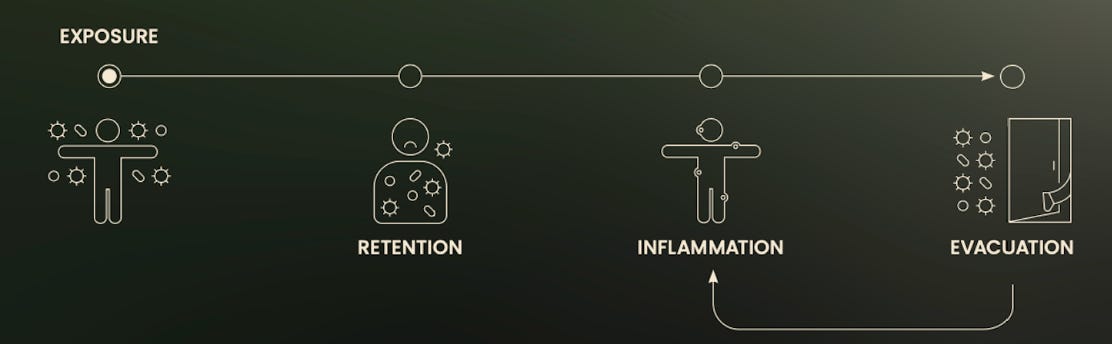
When you breathe in mold spores or their toxins in a water-damaged building, it sets off a biological chain reaction called the biotoxin pathway.
Mold toxins enter the body.
In most people, the immune system “tags” and eliminates them.
But, in those who can’t, those toxins get “stuck”, recirculating and triggering chronic inflammation.
The Genetic Factor
About 1 in 4 people carry a variation in the HLA-DR gene that prevents them from properly clearing mold toxins.
For these individuals, simply moving out of a moldy environment doesn’t always bring relief. The toxins stay inside, looping inflammation over and over again.
That inflammation touches everything — immune signaling, hormones, brain function, and energy metabolism.
Symptom Clusters
One of the main reasons why mold illness is so confusing (and often missed or misdiagnosed) is that its varied symptoms don’t fit into a neat diagnostic box.
One day, you may struggle with crippling brain fog, while the next day, you may deal with joint pain, dizziness, and/or anxiety.
This is because mold follows a predictable process called the Biotoxin Pathway.
When your body can’t clear mold toxins, these trigger a flood of inflammatory messengers called cytokines.
Those cytokines travel through your body, disrupting cell communication and driving inflammation everywhere — brain, endocrine system (hormones), immune system, and digestive system (gut).
Symptoms may include (but are not limited to):
General: fatigue, weakness, headaches
Cognitive: brain fog, poor memory, word-finding issues
Respiratory: cough, congestion, wheezing, new-onset asthma
Neurological: dizziness, tinnitus, blurred vision, numbness
Mood & neurobehavioral: anxiety, depression, irritability, mood swings
Immune: recurrent infections, unexplained inflammation
Dermatologic: rashes, hives, skin irritation
No wonder so many patients get misdiagnosed with chronic fatigue syndrome, fibromyalgia, IBS, anxiety, migraines, multiple sclerosis, lupus, or even early Alzheimer’s.
These diagnoses describe the symptoms, but completely miss the potential environmental trigger underneath.
Do these symptom clusters sound familiar to you? Have you ever wondered if your fatigue, brain fog, and skin issues could all have the same hidden cause? Take this free questionnaire to see if your symptoms line up with mold toxicity.
Why Your Doctor Might Miss Mold
Most primary doctors unfortunately aren’t trained to recognize mold-related illness.
It doesn’t show up on standard lab tests. A doctor may order a panel for you, and this panel could come back “normal”. You’ll be told you’re fine.
Meanwhile, the symptoms mimic dozens of other conditions — from anxiety and fibromyalgia to IBS, chronic fatigue, or even “just aging”. Medical schools don’t teach the nuances of biotoxin illness, which leaves patients misdiagnosed or dismissed.
It’s not because doctors don’t care. It’s because the system hasn’t fully caught up yet.
Why Most Mold Tests Fall Short
When people suspect mold, they often turn to tests that sound simple, but don’t tell the full story.
Petri dish kits — These only measure spores in the environment, not how your body is responding.
Urine mycotoxin tests — These definitely detect mycotoxins, but these toxins can show up in healthy people too, often from food. They can’t distinguish between dietary exposure and toxic retention.
Allergy tests — These measure immune reactivity, but don’t capture the chronic inflammatory response caused by mold toxins.
These can leave people more confused than when they started.
The Gold Standard: Blood Testing
So, is there a blood test for mold exposure?
Yes, and it’s the only evidence-based way to know what’s actually happening in your body.
Blood tests measure the immune and inflammatory markers that reveal whether mold toxins are disrupting your system.
Some of the most informative markers include:
MSH (Melanocyte-Stimulating Hormone): Often suppressed in chronic mold illness.
TGF-β1 (Transforming Growth Factor Beta 1): A key cytokine elevated in biotoxin-related inflammation.
MMP-9 (Matrix Metalloproteinase-9): An enzyme that signals systemic inflammatory activity.
They’ve been validated in peer-reviewed research papers for decades, with protocols pioneered by Dr. Shoemaker and now used by mold-literate clinicians worldwide.
For anyone wondering how to test for mold exposure in the body, blood testing is the most reliable starting point.
One accessible option that I highly recommend is MoldCo, which offers a full range of tests. They also provide free resources if you’re not ready to test yet.
What You Can Do Today
You absolutely don’t need to wait for a diagnosis to start taking action.
The two most powerful steps you can take right now involve simply paying attention to both your body and your home.
Listen to your body’s signals. Mold rarely looks like just one problem. Instead, it shows up as a collection of symptoms that seem entirely unrelated. If you’ve noticed patterns like these, the first step is listening to your body and connecting the dots. This free questionnaire can help you recognize whether your symptoms match the mold toxicity pattern.
Look closely at your home. Your environment is the other half of the equation. A musty, earthy smell is one of the most reliable signs of active mold. Always follow your nose. Start by checking for mold in the most common hotspots below. For a full room-by-room checklist of what to look for, explore MoldCo’s free Home & Health Guide.
Under sinks and around plumbing
Bathrooms with poor ventilation
Condensation around windows or exterior walls
Basements, crawl spaces, and attic
Laundry rooms and HVAC systems
Beyond awareness, here are three simple steps you can take today to reduce mold risk in your home environment:
Keep indoor humidity below 50%. A $10 hygrometer can help you track this.
Run a dehumidifier or high-quality air purifier (options here). This reduces mold growth and spore circulation.
HEPA vacuum regularly (options here). This keeps spores from accumulating in carpets, fabrics, and dust.
These steps are not a replacement for testing, but they will definitely empower you to start creating a healthier home environment right away.
From my detox lens, mold is never just an isolated issue—it overwhelms the body’s natural detox pathways.
When the liver, lymph, and colon are congested, toxins can’t move out and instead “pile up”, fueling the chronic inflammation and symptom clusters described above.
Supporting and reopening these pathways is a crucial part of true recovery, and it’s exactly why deep cellular cleansing and detoxification becomes such a powerful tool.
Want to learn more? Join my free monthly Detox Masterclass on Friday, October 10.
Do these symptoms resonate with you, and do you suspect that you may be struggling with mold toxicity? Have you ever experienced this in the past? Let me know in the comments—I’d love to hear about your journey.
And, if you have any other questions or comments, don’t hesitate to ask me any time in my weekly Q&A in my paid subscriber channel. If you’re not a paid subscriber, sign up below.
If you found this helpful and want to support my writing, here’s how you can help:
Tap the heart so that I know it resonated
Leave a thoughtful comment—I read and appreciate every one!
Forward to a friend who might need to hear it
Share it with your community on Substack Notes, Instagram (tag @meghanswidler), or LinkedIn (and tag me there too!)
Upgrade to a paid subscription below to support deeper work like this
Your support helps me continue creating content that empowers, educates, and liberates. I appreciate it more than you know.
Take my free Detox Phase Quiz to uncover your physical symptoms you’re currently experiencing and to find out where to start your cleansing journey based on your body’s current needs.
Then, explore The Cleanses — a series of powerful digital cleanses that will guide you through a transformative detox journey towards optimal health and vitality, step by step. Whether you’re a total beginner or feel ready for deeper cleansing, these programs are designed to help you feel like your radiant, vibrant self again.
This fall, we’re cleansing together:
The Cleanse begins September 8
The Colon Cleanse begins September 15
The Liver Cleanse begins September 22
Join us live this month for a seasonal reset with community support, or begin anytime if you prefer to move at your own pace.
If you’re ready for a deeply personalized, high-touch experience, I currently have 2-3 spots open for new VIP coaching clients. This is for you if you want a highly customized plan, 1:1 support and guidance, and real accountability to help you heal on every level—physically, mentally, emotionally, spiritually, and energetically. Want to know what it’s like to work with me? Read 50+ client testimonials and see for yourself. I’d love to connect with you.
Would you prefer to connect in person? I’d love to meet you. Come watch me speak at Eudemonia Summit this coming November 13–16. Reserve your spot below, and use code MEGHAN50 for $50 off.
Hi Meghan! Have you done MoldCo’s testing and/or protocol? I just completed my testing with them and I have a high likelihood of mold exposure and symptoms :( Do you recommend their protocol? I’d love to know what you think. Thank you!
Thank you for this! Are mold co labs part of function blood panel?