


Before we dive in, if you want to understand where your gut health actually stands right now, take my free Gut Health Diagnostic in under 2 minutes.
No one taught you what a healthy bowel movement looks like.
Not your doctor, not your school, and certainly not the wellness industry, which would rather sell you a probiotic or a fiber supplement than have this conversation.
So, most people have literally no idea that what they experience in the bathroom every day is one of the clearest windows into what’s happening inside their body, and is also one of the most reliable indicators of whether their terrain is clear or congested.
The Bristol Stool Chart was developed in 1997 at the Bristol Royal Infirmary as a clinical diagnostic tool.
It categorizes stool into 7 types based on consistency and shape. It is used in gastroenterology and clinical research worldwide.
And, almost no one outside of medicine has seen it, which is pretty remarkable, because it is the most practical self-assessment tool for gut health that exists.
If any of these are your normal:
Going less than 2–3 times a day
Wiping a zillion times because it’s never quite finished
Bloating and/or gas after almost every meal
Constipation you’ve stopped even calling constipation
Hard, pebbly, or wildly inconsistent stools
Your gut is asking for support.
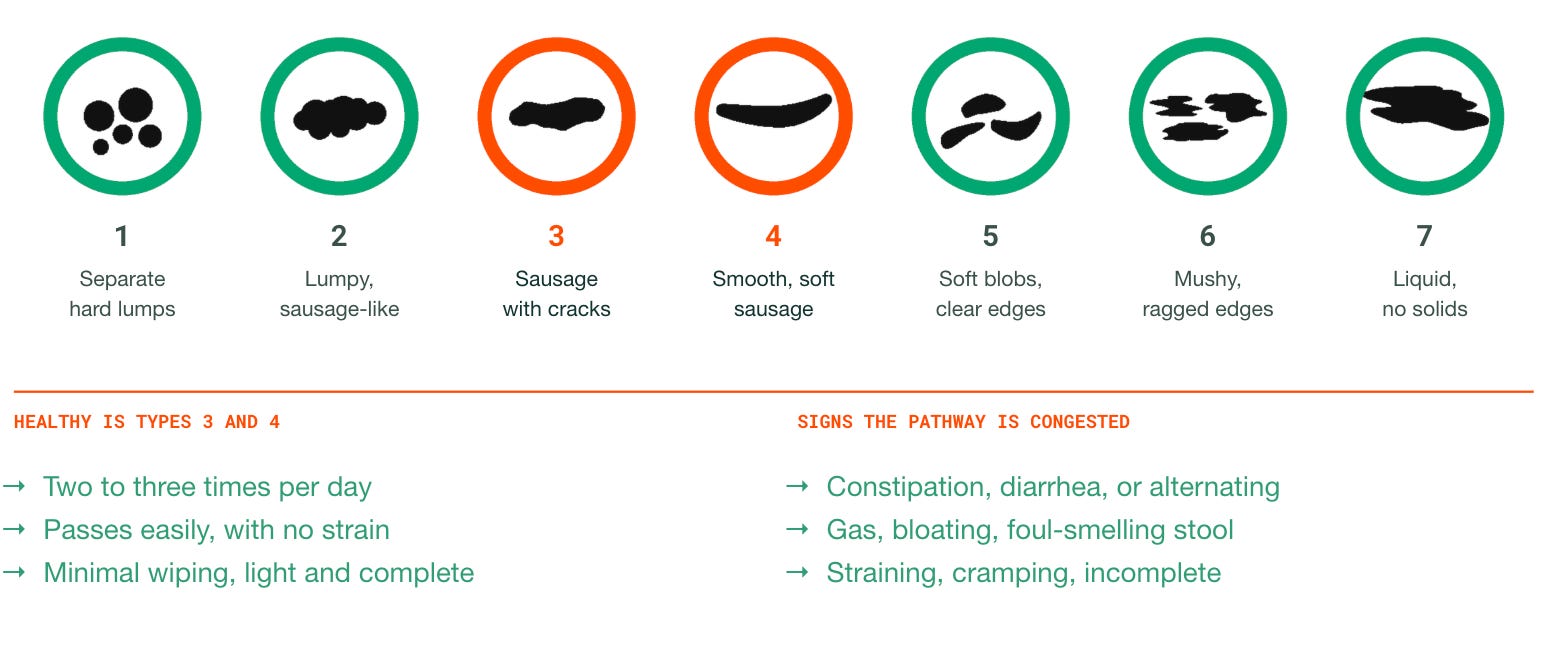
Here’s what the chart is actually telling you.
Types 1 and 2 — separate hard lumps, lumpy and sausage-like — mean your transit time is too slow. Stool is sitting in the colon longer than it should. Estrogen metabolites, toxins, and inflammatory byproducts that should be leaving are being reabsorbed. This is constipation, even if you go every day.
Types 3 and 4 — sausage with cracks, smooth soft sausage — are the target. This is what elimination looks like when the colon is functioning well. Complete, effortless, 2–3 times a day, minimal wiping, light and done.
Types 5, 6, and 7 — soft blobs, mushy, liquid — mean that your transit is too fast. The colon isn’t absorbing what it should. This can indicate gut inflammation, dysbiosis, or a system trying to move something out urgently.
Both extremes are the colon communicating to you.
Constipation says: I’m backed up. Estrogen is recirculating. Toxins are reabsorbing. The liver is working against a closed exit.
Loose stool says: Something is inflamed or irritated. The terrain is reactive. The microbiome may be significantly disrupted.
Most people live somewhere on this spectrum and have normalized it completely.
They’ve stopped calling constipation constipation. They think loose stool is just how they are. They’ve named their bloating after every meal “sensitive digestion”.
None of it is normal.
It’s just common.
Those are two very different words.
An underperforming colon is the foundation of almost every chronic condition women are being handed in their 20s, 30s, 40s, and beyond.
Estrogen recirculates, toxins reabsorb, inflammation builds, and cycles get worse.
A functional gut has 2–3 complete, easy bowel movements a day. Types 3 and 4.
That’s the baseline your body was built for.
The colon is always, always step 1.
Everything upstream — hormones, skin, energy, liver, lymph — depends on it moving properly.
Not a probiotic, not a fiber supplement, not a detox tea, not a liver cleanse.
The colon, open and moving, 2–3 times a day, Types 3 and 4.
That’s where the work starts.
Where does your body sit on this chart right now? Take my free Gut Health Diagnostic to find out, as it will show you exactly where your gut health stands and what to address first.
If this resonated, I’d love to know: was this new information for you, or something you’ve been quietly aware of for a while? Drop it in the comments. I read and reply to every single response.
And, if this sounds like where you are and if you’ve been normalizing symptoms you’ve stopped even naming, I have a few spots open for 1:1 work this fall. The first step is a free 45-minute intake call where we map your terrain and figure out what your body actually needs.
And, if you have any other questions or comments, don’t hesitate to ask me any time in my weekly Q&A in my paid subscriber channel. If you’re not a paid subscriber, sign up below.
If you found this helpful, here’s how you can help:
Tap the heart so that I know it resonated
Leave a thoughtful comment—I read and appreciate every one!
Forward to a friend who might need to hear it
Share it with your community on Substack Notes, Instagram (tag @meghanswidler), or LinkedIn (and tag me there too!)
Upgrade to a paid subscription below to support deeper work like this
Your support means more than you know.
very helpful! confirmed i have issues!