


I told my boyfriend last Monday I had a feeling my period was coming early.
Then, it came.
No tracker, no ring, no wearable, no app.
Just paying attention.
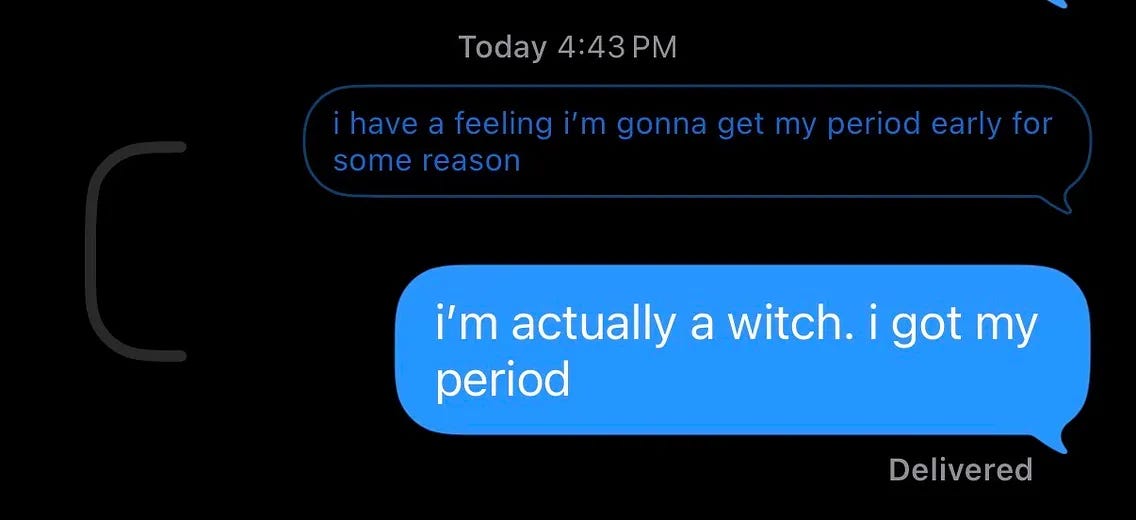
Which has become, somehow, a radical act.
Everyone is tracking everything.
And, I mean...EVERYTHING.
HRV scores.
Glucose spikes.
Step counts.
Zone 2 minutes.
VO₂ max.
Sleep stages.
Recovery percentages.
The quantified self movement is at its peak, and the wellness audience is consuming more biometric data per day than most doctors saw in a year a decade ago.
Yes, we have more data about our bodies than ever before.
But, I’ve been noticing something.
The people most obsessed with their health metrics are often the most anxious and paranoid about their health.
They know their resting heart rate down to the decimal. They’re stressed about whether 62 BPM is better than 64. They check their sleep score before they check in with how they actually feel.
I ditched my ŌURA ring last year for this exact reason.
I noticed I was becoming more focused on the numbers than tuned in to my body.
If my sleep score was “bad” when I woke up, I’d feel off before the day even started, even if I felt totally fine.
There is a real and important difference between tracking biomarkers twice a year, from a place of curiosity, to inform health decisions...and being notified every 90 seconds that your blood sugar spiked, your HRV is suboptimal, your sleep score dropped 12 points, and your stress is elevated.
The first builds awareness.
The second builds anxiety.
Chronic exposure to your own real-time stress data is itself a massive stressor.
The nervous system that you are trying to optimize is the same nervous system reading the score and contracting around it.
The feedback loop becomes self-reinforcing.
The data tells you your cortisol is high.
The data spike makes your cortisol higher.
The body, perceiving constant surveillance, never gets the signal that it is safe.
This matters because the body does not heal in fight-or-flight.
Drainage slows, digestion stalls, hormones dysregulate, detoxification capacity drops.
The very systems you are trying to measure into submission go quiet under the weight of being watched.
Meanwhile, the women who feel their period coming three hours early — without an app, without a wearable on their wrist — are doing the thing wearables were invented to replicate.
We’ve outsourced body awareness to wearables, and then wondered why we feel disconnected from ourselves.
The healthiest people I know check their biomarkers a few times a year, from a place of curiosity, and otherwise live in their bodies.
They eat real food, sleep, move, spend time outside, get natural sunlight, make sure their detox pathways are open, and prioritize connection and intimacy over optimization.
They are not less serious about their health.
They are less afraid of it.
There is a place for data.
There is no place for paranoia disguised as wellness.
The most advanced biofeedback tool you own is the one you were born with.
Body literacy is the “optimization” no one is selling you.
If you want a real baseline for where your cycle actually is (not what an app told you, but a clinical-style assessment), my Cycle Audit walks you through it.
If this resonated, I’d love to know: when was the last time you trusted a signal from your body before checking the app or the score? Let me know in the comments. I read and reply to every response.
And, if you’re ready to address the actual terrain rather than layer more inputs onto a system that hasn’t been cleared, I’m currently taking a very limited number of new 1:1 coaching clients. Book a consultation here.
And, if you have any other questions or comments, don’t hesitate to ask me any time in my weekly Q&A in my paid subscriber channel. If you’re not a paid subscriber, sign up below.
If you found this helpful, here’s how you can help:
Tap the heart so that I know it resonated
Leave a thoughtful comment—I read and appreciate every one!
Forward to a friend who might need to hear it
Share it with your community on Substack Notes, Instagram (tag @meghanswidler), or LinkedIn (and tag me there too!)
Upgrade to a paid subscription below to support deeper work like this
Your support means more than you know.
This really hits home! I often get so focused on hitting that perfect zone 2 pace that I overlook how amazing my run actually felt, who I shared it with, and the signals my body is sending both during and after. Data has its place, as you said, but it was a great reminder to not forget it’s just one part of the bigger picture, other elements are just as crucial for truly understanding our well-being and connecting to our own wisdom.
So important! I‘ve had the same experiences with fitness trackers. This always reminds me of something from quantum physics I once heard. Measuring a particle inevitably changes it. You can’t observe without interfering.
Maybe the same seems to be true for our bodies. 🧡