


Before we get into it, take my free Gut Health Diagnostic. It takes 2 minutes, and knowing where your own digestion and elimination stand right now will make everything below land a lot more personally.
Nearly 1 in 8 American adults are now taking a GLP-1 medication (!!!!!).
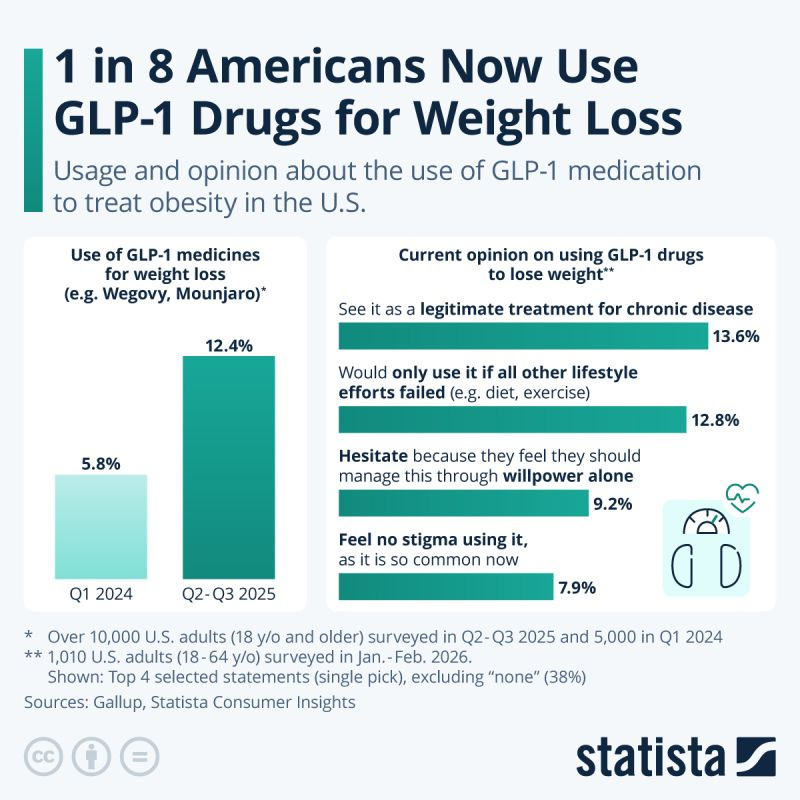
Not just for diabetes. For weight loss, cardiovascular risk, sleep apnea, kidney disease, liver disease, addiction, binge eating, and now general “metabolic optimization”.
GLP-1 prescriptions for obesity have grown dramatically in the last five years.
The global market is projected to hit $200 billion by 2030.
Up to 30 million Americans may be on these drugs by the end of the decade.
The pharmaceutical industry has found a single molecule it can prescribe for almost everything.
And, when one molecule is the answer to nine unrelated questions, that is worth slowing down on.
I covered how these drugs actually work back in April. That piece is here.
This one is about what they’re doing to your digestion and drainage, which no one seems to be talking about.
GLP-1s slow gastric emptying, reduce gastric acid output, suppress post-meal gallbladder contraction, and alter gut motility.
Every single one of those affects how your body digests, absorbs, and clears what comes in.
Slower gastric emptying means food sitting longer than it should. That one is not a side effect, by the way. That one is the drug working exactly as designed.
Reduced gastric acid output combined with slowed gastric emptying means protein digestion and mineral absorption are impaired independent of caloric intake. That is why muscle loss on GLP-1s consistently outpaces what caloric restriction alone would predict, and why B12, iron, and magnesium absorption issues show up in the literature independent of weight loss.
Suppressed post-meal gallbladder contraction means the liver’s primary exit route for hormones, cholesterol, and fat-soluble toxins backs up. GLP-1s directly suppress the CCK-mediated signal that tells your gallbladder to contract at meals, so bile that would normally move sits instead. Meta-analyses of randomized trials show an approximately 37% increased relative risk of gallbladder and biliary disease (absolute risk roughly 1.5% vs. 1.2% baseline). Rapid weight loss is an independent gallstone risk factor as well, which compounds the picture.
Altered colon motility means whatever the liver did manage to dump gets caught between slowed transit for some users and diarrhea for others, depending on the specific mechanism at play.
For someone whose terrain is already congested, including a sluggish gut, an overburdened liver, and poor drainage, these are the exact systems that go further offline.
You’re losing weight, but you’re also losing your body’s ability to process, absorb, and eliminate.
The weight does come off, primarily because you are eating less. But the terrain underneath is also being affected, and the two are happening at the same time.
56% of users discontinue within a year.
And, they come off into a body with less muscle, less bone density, fewer stored minerals, and a digestive system that has been running differently for months.
Two-thirds of the weight comes back per five-year STEP-1 extension data.
The cardiometabolic improvements revert with it.
To be clear, I am not anti-medication.
There are people for whom these drugs are genuinely appropriate, and for some of them, they are life-changing. I am not interested in shaming anyone who is on one, either.
What I am interested in is the order.
Because this is the same playbook the food industry has run for fifty years.
Engineer the problem, sell the intervention, never name the terrain.
You can’t suppress your way into a functioning metabolism.
The fastest way to a healthy metabolism is not a shot or a pill.
It is open drainage.
If this hit, I would love to know: what happened to your digestion while you were on one, or after you came off? Whether you’re currently on a GLP-1, considering one, or a year past it, I want to hear it. Let me know in the comments. I read and reply to every response.
If you haven't yet, my free Gut Health Diagnostic will show you what your gut is actually telling you right now.
If you’re ready to address the actual terrain rather than layer more interventions onto a system that hasn’t been cleared, I’m currently taking a very limited number of new 1:1 coaching clients for August and September. The first step is a 45-minute Client Intake call where we map your full picture and figure out together whether the work is the right fit for where you are. Book your free Client Intake call.
And, if you have any other questions or comments, don’t hesitate to ask me any time in my weekly Q&A in my paid subscriber channel. If you’re not a paid subscriber, sign up below.
If you found this helpful, here’s how you can help:
Tap the heart so that I know it resonated
Leave a thoughtful comment—I read and appreciate every one!
Forward to a friend who might need to hear it
Share it with your community on Substack Notes, Instagram (tag @meghanswidler), or LinkedIn (and tag me there too!)
Upgrade to a paid subscription below to support deeper work like this
Your support means more than you know.
Protein and minerals are not going "unbroken-down." The stomach's pH is overly-acidic and GLP1 medications do not make the pH less acidic. You're not losing your body's ability to process or absorb. You're losing weight because you're *consuming less.*
It's also interesting to look further into your concerns about biliary disease. 37% more common than placebo. What does that mean in real-world numbers? About 1.5% of people on GLP1 medications experienced gallbladder/biliary disease while 1.2% of people in the control group experienced these problems. For every 370 people on GLP1 over the course of a year, you'd expect 1 extra case of gallbladder/biliary disease.
Even more interesting is the risk for gallbladder/biliary disease was higher in people using GLP1 for weight loss than it was for people using it for diabetes. We know obesity and rapid weight loss are both risk factors for gallstones, so it's likely not as much an effect of the medication as it is an effect of the underlying obesity and the medication resulting in actual weight loss.