

Before we dive in, take my free Hormone Health Scorecard to understand where your hormonal terrain actually stands. It takes two minutes.
Testosterone prescriptions for women jumped 146% between January 2023 and July 2026, according to a Truveta analysis for Reuters.
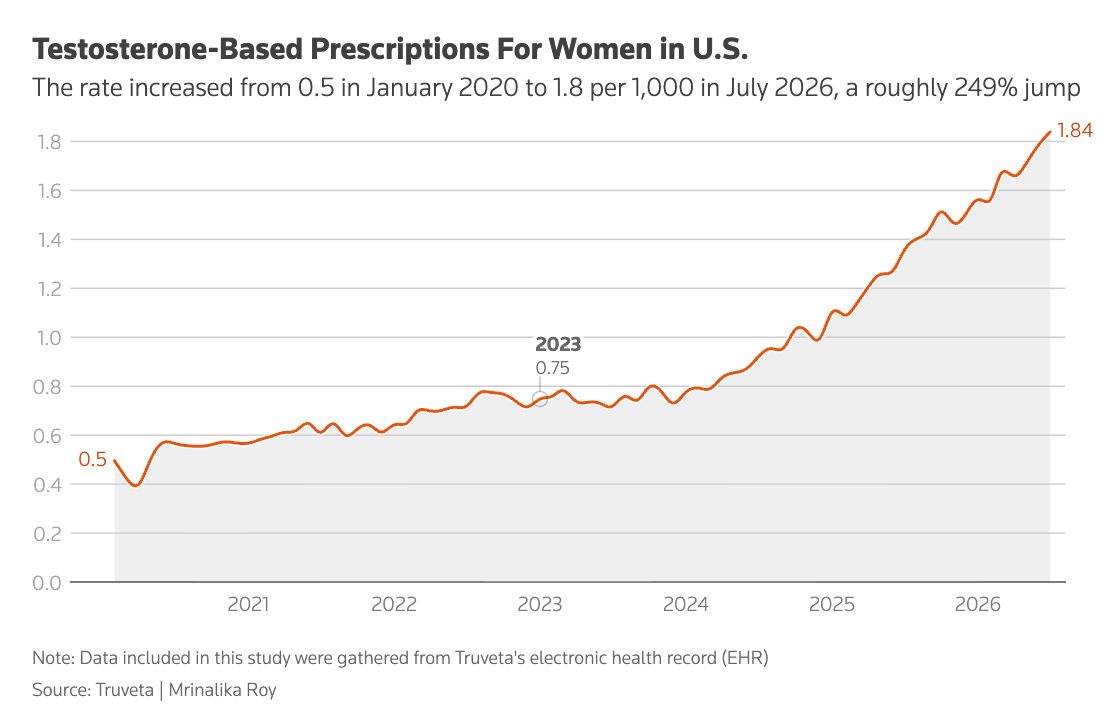
There’s still no approved testosterone product for women in the US.
So, women are splitting gels designed for men, often at many times the dose they actually need, and pharmacies are starting to push back.
And, last month, the FDA held its first public workshop on testosterone for menopausal women.
The demand is real, and the symptoms are real.
But, the only use with real clinical evidence behind it is low sexual desire after menopause. Mayo Clinic’s Dr. Stephanie Faubion, medical director of The Menopause Society, said there’s no evidence it improves muscle, bone density, mood, or well-being in women.
What it’s being sold for online isn’t what the data supports.
Meanwhile, fatigue, brain fog, and poor recovery are driving a lot of these prescriptions.
And, because testosterone levels in women are so low to begin with, there’s no blood-test threshold that can actually diagnose a deficiency.
So, we have a hormone being prescribed for symptoms it hasn’t been shown to fix, based on a number that can’t reliably define “low”.
I’m not here to argue against hormone replacement therapy.
There are women for whom the terrain work has been done and replacement is genuinely the right clinical move.
What I keep coming back to is the sequencing.
Low testosterone in women is almost never a production failure.
It’s a signal.
Cortisol and testosterone share biosynthetic resources.
Under chronic stress, the body deprioritizes sex hormone production — from a survival standpoint, it’s less important than keeping the threat response online. Sustained cortisol elevation depletes testosterone over time.
This isn’t a testosterone deficiency.
It’s an HPA axis dysregulation problem wearing a testosterone deficiency costume.
The liver metabolizes and clears sex hormones. When the liver is overburdened — congested from toxic load, poor bile flow, accumulated hormonal burden from years of synthetic contraception — it can’t process testosterone and its metabolites efficiently. What should be cleared ends up recirculating. What should be produced gets disrupted downstream.
Nutritional depletion drives the whole thing. Zinc is required for testosterone synthesis. Vitamin D functions as a steroid hormone precursor. Magnesium is essential for HPA axis regulation.
Most women presenting with low testosterone are significantly depleted in one or more of these, and most standard labs never test intracellular levels.
Thyroid dysfunction suppresses sex hormone production across the board. And most thyroid panels don’t test free T3 (the active form), so the connection gets missed entirely.
In practice, I see women whose testosterone is low, whose symptoms are real and debilitating, who improve significantly when drainage is opened, the liver is supported, the HPA axis is given the right conditions, and the nutritional gaps are addressed.
Without a single milligram of exogenous hormone.
Not always. But often enough that it changes the question.
The question I wish was standard before every hormone prescription:
Have we actually assessed and addressed the terrain? The drainage? The gut? The liver? The HPA axis? The nutritional status? The toxic burden?
Or are we replacing what the body stopped making before asking why it stopped making it?
There are women who need HRT. There are women who need testosterone.
They deserve products actually designed and dosed for them, and the FDA finally signaling a path to approval is a good thing.
But, sequencing matters.
Terrain first.
Then, evaluate what still needs addressing.
Adding hormones to a system that cannot clear them, metabolize them, or use them efficiently is not restoration.
It’s layering inputs onto a backed-up system.
The outcomes are predictably partial.
What’s your experience with this? Have you been offered HRT or testosterone before anyone even actually looked at the underlying terrain? Drop it in the comments. I read and reply to every single one.
Take my free Hormone Health Scorecard — it takes 2 minutes and will show you exactly which root causes are most relevant to your specific symptom picture.
And, if you’re ready to do this work directly, I have a few spots open for 1:1 work this fall. The first step is a free 45-minute intake call.
Or, join me for my free live Detox Masterclass on November 17, where I’ll walk through the full sequence and take live questions at the end.
And, if you have any other questions or comments, don’t hesitate to ask me any time in my weekly Q&A in my paid subscriber channel. If you’re not a paid subscriber, sign up below.
If you found this helpful, here’s how you can help:
Tap the heart so that I know it resonated
Leave a thoughtful comment—I read and appreciate every one!
Forward to a friend who might need to hear it
Share it with your community on Substack Notes, Instagram (tag @meghanswidler), or LinkedIn (and tag me there too!)
Upgrade to a paid subscription below to support deeper work like this
Your support means more than you know.
Not on my private newsletter yet?
That’s where masterclass invitations, cohort openings, and waitlists go. Substack essays cover the writing. My newsletter covers the offers.