


Before we dive in, if you want to understand where your menstrual cycle health stands right now, take my free Cycle Audit before reading. It takes 2 minutes and will make everything below much more personal.
I had a hormonal Mirena IUD for five years.
But honestly, that was just the last chapter.
Before the IUD, I had been on some form of hormonal contraception for probably a decade — the pill in various forms, cycling through whatever my doctor suggested at the time.
Like most women, I was put on it young, told it was safe, and never given a reason to question it.
So, by the time I finally had the IUD removed in October 2021, my body hadn’t run on its own hormonal cycle in over a decade.
My liver had been processing synthetic hormones since I was a teenager.
My estrobolome had never had the chance to develop properly around my own estrogen clearance.
My HPA axis had been operating under suppression for so long that it genuinely didn’t know how to regulate itself without the synthetic signal.
I was told for years the IUD was the safest option.
What I wasn’t told: that over ten years of synthetic hormones would leave my body with no idea how to regulate itself when they were finally removed.
What I also wasn’t told: that my liver, which had spent years processing synthetic hormones, would be congested and behind on its own estrogen clearance by the time I came off it.
And, what nobody in conventional medicine seems to talk about at all: that the symptoms most women experience after stopping hormonal contraception — the acne, the irregular cycles, the mood dysregulation, the hair loss, the fatigue, the anxiety — are not random.
They are not just “your hormones adjusting”.
They are a predictable, biological consequence of what synthetic hormones do to the terrain over time.
Here’s what’s actually happening.
What Hormonal Birth Control Does To Your Body Over Time
Hormonal contraception — the pill, the patch, the ring, the IUD, the implant — works by suppressing ovulation and altering the hormonal environment of the reproductive system.
Most people know this part (I hope).
What most people don’t know is what happens systemically over months and years of use.
Your liver processes every synthetic hormone you take.
The pill in particular runs a significant burden through hepatic Phase I and Phase II detoxification pathways — the same pathways responsible for clearing your own natural estrogen, processing toxins, producing bile, and supporting hundreds of other metabolic functions.
Years of synthetic hormone load congests those pathways.
By the time you stop, the liver is behind.
Hormonal contraception depletes specific nutrients the body needs to regulate hormone production and detoxification, including B vitamins including folate and B6, zinc, magnesium, selenium, and CoQ10.
These are not trivial depletions.
B6 is critical for progesterone production.
Zinc is essential for follicle-stimulating hormone signaling.
Magnesium is involved in over 300 enzymatic reactions including those governing the stress response.
Coming off the pill into a nutrient-depleted body means the system trying to restart is already running on empty.
The gut microbiome shifts under prolonged hormonal contraception, specifically the estrobolome, the collection of gut bacteria responsible for metabolizing and clearing estrogen.
When the estrobolome is disrupted, estrogen clearance becomes inefficient, and estrogen recirculates instead of being excreted.
Estrogen dominance builds even as natural production is trying to resume.
The HPA axis — the brain-adrenal communication system governing cortisol, stress response, and by extension sex hormone production — is suppressed under hormonal contraception and needs time to recalibrate.
For some women, this happens quickly.
For others, particularly those who started young or used it for a decade or more, it can take a year or longer.
What Post-Pill Syndrome Actually Is
Post-pill syndrome is not an official diagnosis. It is a clinical reality that millions of women live through with no framework for understanding it.
The symptoms are predictable and they cluster:
Acne, often cystic, along the jawline and chin
Hair loss
Irregular or absent periods as the hypothalamic-pituitary-ovarian axis restarts
Mood dysregulation
Fatigue
Anxiety
Bloating
Weight changes
Low libido
These symptoms are not your body failing.
They are your body attempting to restart a system that has been suppressed, often for years, without the nutritional resources or drainage capacity to do it cleanly.
The acne, in particular, is a drainage story.
The liver, congested from years of synthetic hormone processing, is clearing a backlog. Androgens, which were suppressed by the pill, rebound. Estrogen, without efficient clearance pathways, recirculates.
All of it shows up on the skin because the skin is a secondary elimination organ — it takes over when the primary pathways are overloaded.
This is exactly what happened to me.
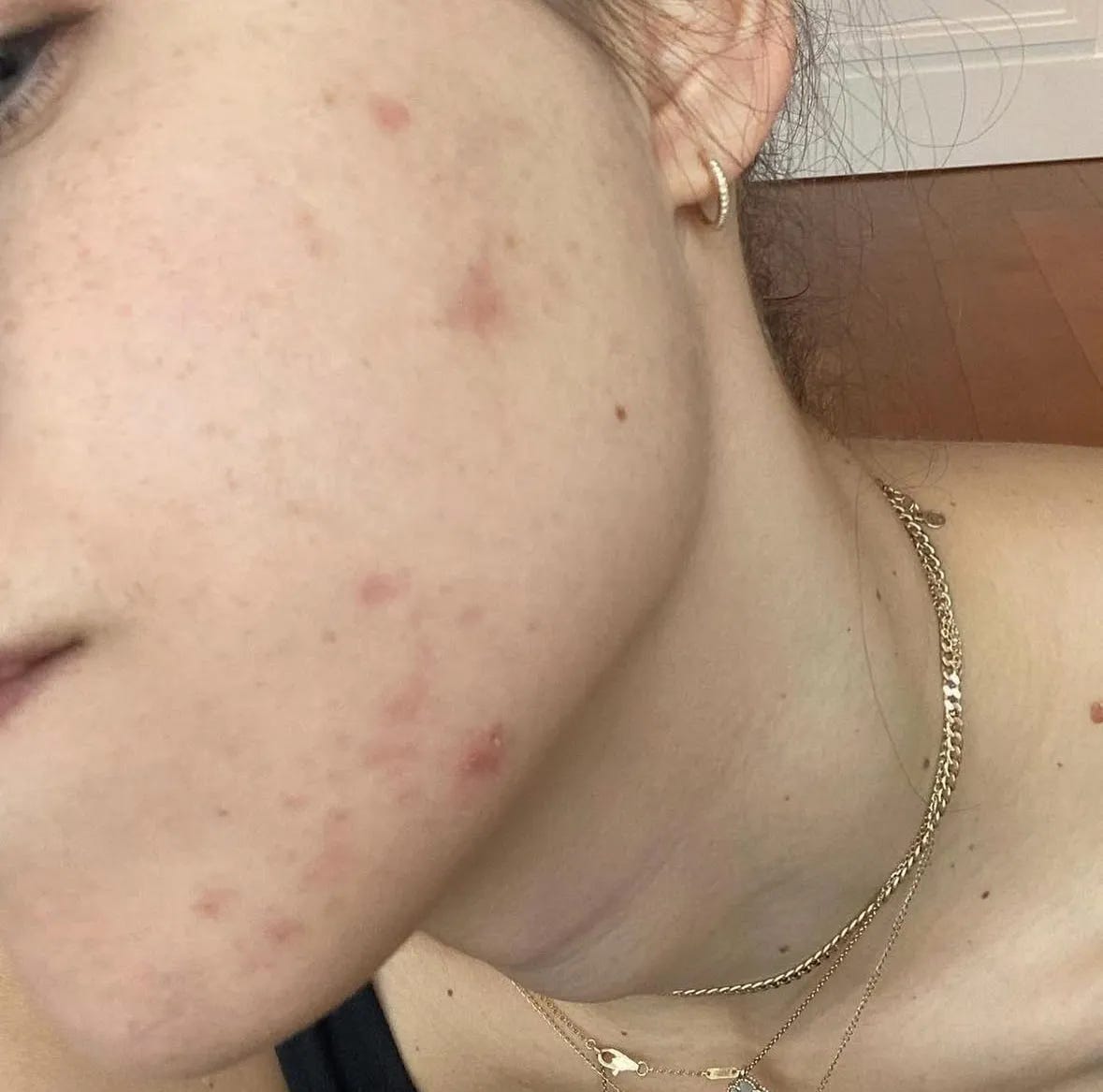
In 2021, after the IUD was removed, my skin erupted with deep, cystic acne along my cheeks, jawline, and back. I was doing everything right — eating clean, moving daily, sleeping well, managing stress.
Nothing worked.
Because nothing I was doing was addressing the actual problem.
The problem was a congested liver sitting on a decade of synthetic hormone burden with no clear pathway out.
What Actually Helps
This is where conventional medicine leaves most women completely stranded.
The standard response to post-pill symptoms is to go back on hormonal contraception, or to treat each symptom in isolation — a topical for the acne, an antidepressant for the mood, an iron supplement for the fatigue.
None of that addresses the terrain.
What actually moves the needle:
Supporting liver detoxification specifically — Phase I and Phase II — so that synthetic hormone metabolites clear efficiently and natural hormone processing can resume. This is not a supplement recommendation, but rather, proper drainage work done in the correct sequence.
Replenishing the specific nutrients depleted by hormonal contraception before trying to support hormone production. You cannot build progesterone without B6 and zinc, and you cannot regulate cortisol without magnesium. The foundation has to come first.
Restoring the estrobolome — the gut bacteria responsible for estrogen clearance. This is not just a general probiotic, but rather is targeted gut work that addresses the specific microbial shifts caused by prolonged hormonal contraception.
Supporting lymphatic flow. The lymphatic system drains the inflammatory waste that accumulates as the body clears synthetic hormone metabolites. When it’s stagnant (and it almost always is), that inflammatory burden sits in tissue, including skin tissue.
Opening the colon. If you are not eliminating two to three times daily, everything upstream is backing up. Estrogen that should be excreted is being reabsorbed. The detox chain breaks at the exit.
This is the sequence.
This is why people who take supplements and eat clean and still struggle post-pill are not failing.
The terrain hasn’t been cleared.
The foundation hasn’t been built.
And without that, the body is trying to restart in an environment that isn’t ready to support it.
I came off my IUD in October 2021.
My skin went absolutely insane, as you can see in the photo above.
My cycle took months to regularize.
Nobody gave me a framework for what was happening or why.
I built one.
That framework — the sequence, the drainage work, the terrain approach — became The Reset.
It’s the same work I do with every client whose hormonal disruption history traces back to years on the pill or a hormonal IUD.
If you came off birth control and felt like your body went sideways, you are not broken and you are not imagining it.
You just needed someone to explain what was actually happening.
Now, you have it.
By the way, one tool I genuinely recommend for women coming off hormonal contraception: Natural Cycles — an FDA-cleared app that uses your basal body temperature to track your cycle naturally, without synthetic hormones. It's how I learned to actually understand my own cycle after years of suppression. Use code MEGHAN15 for 15% off at checkout.
Where are you in this picture? Take my free Cycle Audit to find out.
If this resonated, I’d love to know: how long were you on hormonal contraception, and what happened when you stopped? Let me know in the comments. I read and reply to every response.
If you’re tired of trying to figure this all out on your own and want guided, highly personalized, root-cause support, I’m currently taking a very limited number of new 1:1 coaching clients. Book a consultation with me here.
And, if you have any other questions or comments, don’t hesitate to ask me any time in my weekly Q&A in my paid subscriber channel. If you’re not a paid subscriber, sign up below.
If you found this helpful, here’s how you can help:
Tap the heart so that I know it resonated
Leave a thoughtful comment—I read and appreciate every one!
Forward to a friend who might need to hear it
Share it with your community on Substack Notes, Instagram (tag @meghanswidler), or LinkedIn (and tag me there too!)
Upgrade to a paid subscription below to support deeper work like this
Your support means more than you know.
This just ignited a realisation in me… after being on the pill for 11 years, after having my daughter I decided I no longer wanted to be on it. As predicted it was years of issues. But one of them I had not related to this was getting Gilbert’s syndrome which I had never had prior and believed the gene must have been turned off after a stressful birth or stress of being a mother. Now this makes perfect sense to me because Gilbert’s syndrome is the liver not being able to process Bilirubin from the blood. Making me wonder if this was all of the years of hormone taking that led to the Gilbert’s gene being turned on 🤔