

Before we dive in, if you want to start where I start with every client, grab my free Drainage Starter Guide. It walks you through the first steps that make every other number in this post easier to move.
I run my labs twice a year, and I’ve done it for years.
I don’t do it to chase perfect numbers.
I do it because numbers tell me whether what I’m doing is actually working, or whether I’m just hoping it is.
I test through Function Health, where I’m also an active investor because I believe in what they’re building. You can join here (using my code to skip the waitlist).
This year, I also added a second DEXA scan.
So, this is what my numbers say, what they mean, and what I think moved them.
Part 1: The numbers I’ve worked for
My DEXA scan
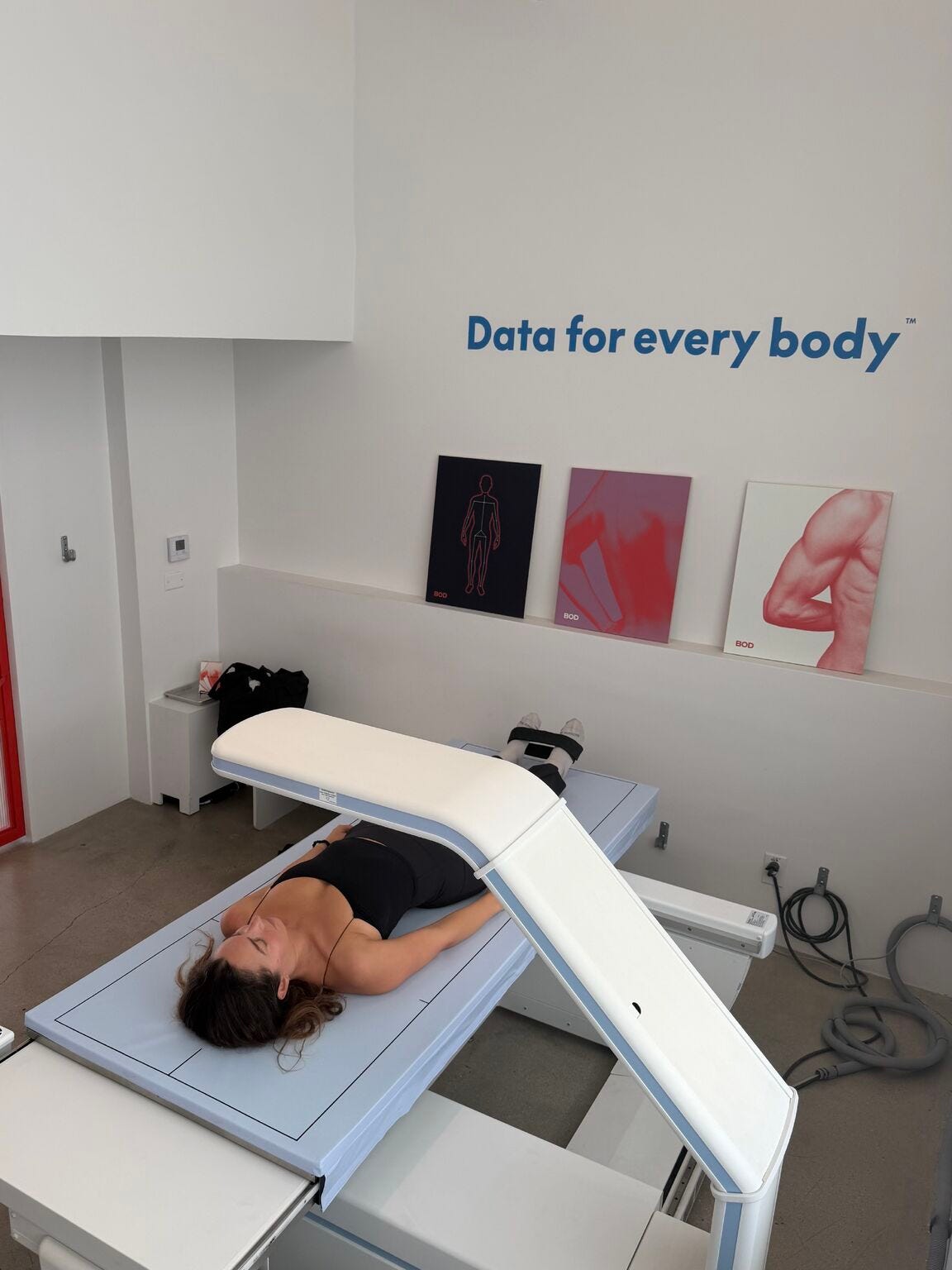
I got my second DEXA scan at BOD Venice, 173 days after my first.
Lean mass: up 4.9 pounds
Body fat: down 1.1 pounds
Body fat percentage: down 1.5 points
Visceral fat (the inflammatory fat wrapped around your organs): down 36%, from 0.73 to 0.47 pounds
Bone density: up 4%
The lean mass number is the one I’m proudest of. It works out to roughly 0.8 pounds a month. Women who already train usually add closer to half a pound a month, and that’s under ideal conditions.
My lean mass index went from 15.23 to 15.97.
And, my total weight went up almost 4 pounds.
On a scale, that looks like I went backwards. That’s exactly why I don’t own one. A scale can’t tell muscle from fat, or bone from belly fat.
My week usually looks like this:
Heated weighted mat Pilates, two times a week
Strength training, two to three times a week
A long hike (about 10 miles), once a week
Hot yoga, once a week
6,000 to 10,000 steps a day
Plus enough protein, real whole foods, good sleep, and daily terrain work.
Most women my age are quietly losing muscle and bone every year. Building both is one of the best longevity investments you can make.
If you’re in LA, code BOD-MEGHAN gets you 25% off a DEXA at BOD.
My metabolic health
Between May and September:
Fasting insulin: 4.3 → 3.1
Fasting glucose: 95 → 84
Hemoglobin A1c: 5.5 → 5.4
All three were already in a healthy range in May. They still moved in the right direction.
Fasting insulin is the one I’d ask everyone to test.
It can climb for years before glucose or A1c look off. The average American adult sits around 10, and most labs call anything up to about 25 “normal”.
My triglycerides (61) and HDL (60) back this up. A triglyceride-to-HDL ratio around 1 is a good sign your body handles glucose well.
I don’t fast for days, eat keto, or take metformin or berberine. This is what I do:
Go on a 10-minute walk after meals whenever I can, especially after dinner
Lift heavy two to three times a week
Protect my sleep
Eat most of my carbs earlier in the day
Eat enough protein
Keep my bowels moving and my liver supported, since the liver clears a big share of your insulin
My inflammation
My hs-CRP came back under 0.2 mg/L, in both May and September.
hs-CRP is a marker of systemic inflammation. Under 1.0 is considered low risk. Under 0.2 is about as low as the test reads.
Chronic, low-grade inflammation sits underneath almost every symptom my clients come in with: bloating, breakouts, fatigue, and brain fog. Keeping drainage open, the gut healthy, and the liver supported is how I keep mine low.
My liver enzymes
ALT: 14 U/L. AST: 18 U/L.
These two enzymes leak into your blood when liver cells are stressed or damaged. Mine are low and healthy, and they’ve stayed that way across every panel this year.
Your liver is your body’s processing plant. It filters your blood, packages up used hormones and toxins so they can leave, makes bile, and clears a big share of your insulin. When it’s overburdened, you feel it everywhere: in your skin, your hormones, your energy, and your digestion.
So, I prioritize liver-loving foods and juices every day: bitter greens, beets, cruciferous veggies, and fresh green juices. And, I keep my colon moving, so what my liver packages up actually leaves my body.
My heart markers
ApoB: 75 mg/dL (optimal is under 90). ApoB counts the particles that actually carry cholesterol into your artery walls. Many experts consider it a better read on cardiovascular risk than LDL alone.
Lp(a): under 10 nmol/L (optimal is under 75). Lp(a) is largely genetic, and most people never get it tested. It’s worth checking at least once in your life.
Part 2: My AMH, with context
Over the summer, I shared that my AMH is 3.49 ng/mL at 34. That’s higher than average for my age. A lot of you had thoughtful responses, and a few of you rightly pointed out that AMH isn’t the full fertility picture.
You’re right. So, let’s talk about what it can and can’t tell you.
What AMH measures: anti-Müllerian hormone is made by the small follicles in your ovaries. It gives an estimate of ovarian reserve, roughly how many eggs you have left.
What it doesn’t measure: egg quality. And, it doesn’t predict whether you’ll get pregnant naturally. A 2017 study in JAMA followed women aged 30 to 44 who were trying to conceive. Women with low AMH got pregnant at similar rates to women with normal AMH.
What affects it: you’re born with your lifetime supply of eggs, and AMH naturally declines with age. But, the number isn’t set in stone. Research links smoking, hormonal birth control (which can lower it temporarily), and some endocrine-disrupting chemicals to lower AMH.
I can’t prove my work is why mine is higher than average.
But, so much of what I do every day is about protecting my reproductive health: lowering my toxic load, supporting my liver so hormones clear properly, keeping blood sugar steady, and keeping inflammation low.
I still like knowing my number, but I just don’t treat it as a verdict. Egg quality is shaped by many of the same things as everything else in this post.
Part 3: The one I was born with: MTHFR
I carry one copy of the MTHFR C677T variant. (I intuitively knew this all along.)
Somewhere between 30% and 40% of people carry at least one copy. Most never find out.
MTHFR is an enzyme that turns the folate you eat into methylfolate, the active form your body actually uses.
That fuels methylation, a process happening in almost every cell. It helps you clear estrogen, build neurotransmitters like serotonin and dopamine, run phase II liver detox, repair DNA, and keep homocysteine in check.
One copy of C677T lowers enzyme activity by roughly 30%. Two copies, by up to 70%.
Most doctors won’t test for it, because current guidelines say it rarely changes treatment. I understand that. In my work, though, it’s one more piece of the terrain picture. A slower methylation pathway plus toxic load, chronic stress, alcohol, or low B vitamins looks very different from the variant on its own.
Your genes load the gun. Your environment pulls the trigger.
So, I’m not panicking. I support the pathway with methylfolate (which skips a conversion step), methylated B12, and the same drainage, gut, and liver work I do with clients.
Part 4: What I’m working on
Not every number is where I want it, and it never is. I’m human.
Ferritin: 17 ng/mL. Ferritin is your iron storage. My serum iron (78) and iron saturation (24%) are both right where they should be, and my hemoglobin is a solid 14.3. So, a standard blood count would say I’m fine.
And, honestly, I feel completely fine.
But, my ferritin has sat in the mid-teens recently. That’s technically just inside the lab’s range, but much lower than I want it. Your stores are the first thing to drop, long before anything shows up as anemia. That’s exactly why I test ferritin.
So, I’m prioritizing iron-rich foods like sardines, leafy greens, and pumpkin seeds (with a squeeze of lemon for vitamin C), keeping my decaf coffee away from those meals, and planning an iron infusion to boost my ferritin specifically.
Omega-3 index: 4.9%. Optimal is 5.5% or higher. Even eating some high-quality fish, I’m just under it. I’m adding more wild salmon from Seatopia (MEGHAN20 for $20 off), wild sardines, and a quality fish oil.
These aren’t emergencies, but they’re the next layer.
What I want you to take from this
Numbers are a snapshot, not a grade.
What I’m really proud of is the work underneath them: daily habits, drainage, strength training, consistent sleep, and years of learning how my body actually works.
If you’ve never run comprehensive labs, these are the markers I’d start with:
Metabolic health: fasting insulin, fasting glucose, and A1c
Inflammation: hs-CRP
Heart health: ApoB, plus Lp(a) at least once
Liver: ALT and AST
Iron: ferritin, alongside a full iron panel
Thyroid: TSH, free T3, and free T4 (plus antibodies if thyroid issues run in your family)
Nutrients: vitamin D, RBC magnesium, and an omega-3 index
Most standard physicals only cover a few of these. Every lab number in this post came from my Function Health panels, which is the easiest way I know to get all of them at once. Sign up here (using code MSWIDLER10 to skip the waitlist).
And, if you can, definitely add a DEXA scan. It’s the only way to know what’s actually happening with your muscle, fat, and bone.
Which of these numbers would you want to test first? Tell me in the comments.
And, if you already have your labs and want someone to actually read them with you, book a Terrain Audit. It’s a 60-minute, $300 root-cause deep dive. We go through your labs, symptoms, and history together, and you leave knowing exactly what your body is asking for and where to start.
Or, join me for The Blueprint, my free live masterclass on November 17 at 12 PM PT, where I’ll walk through the full detox sequence.
And, if you have any other questions or comments, don’t hesitate to ask me any time in my weekly Q&A in my paid subscriber channel. If you’re not a paid subscriber, sign up below.
If you found this helpful, here’s how you can help:
Tap the heart so that I know it resonated
Leave a thoughtful comment—I read and appreciate every one!
Forward to a friend who might need to hear it
Share it with your community on Substack Notes, Instagram (tag @meghanswidler), or LinkedIn (and tag me there too!)
Upgrade to a paid subscription below to support deeper work like this
Your support means more than you know.
Not on my private newsletter yet?
That’s where masterclass invitations, cohort openings, and waitlists go. Substack essays cover the writing. My newsletter covers the offers.