


Before we dive in: if you want a real read on where your hormones are at right now, take my free Cycle Audit Quiz and Hormone Health Scorecard. Each takes about 3 minutes and will make everything below much more personal.
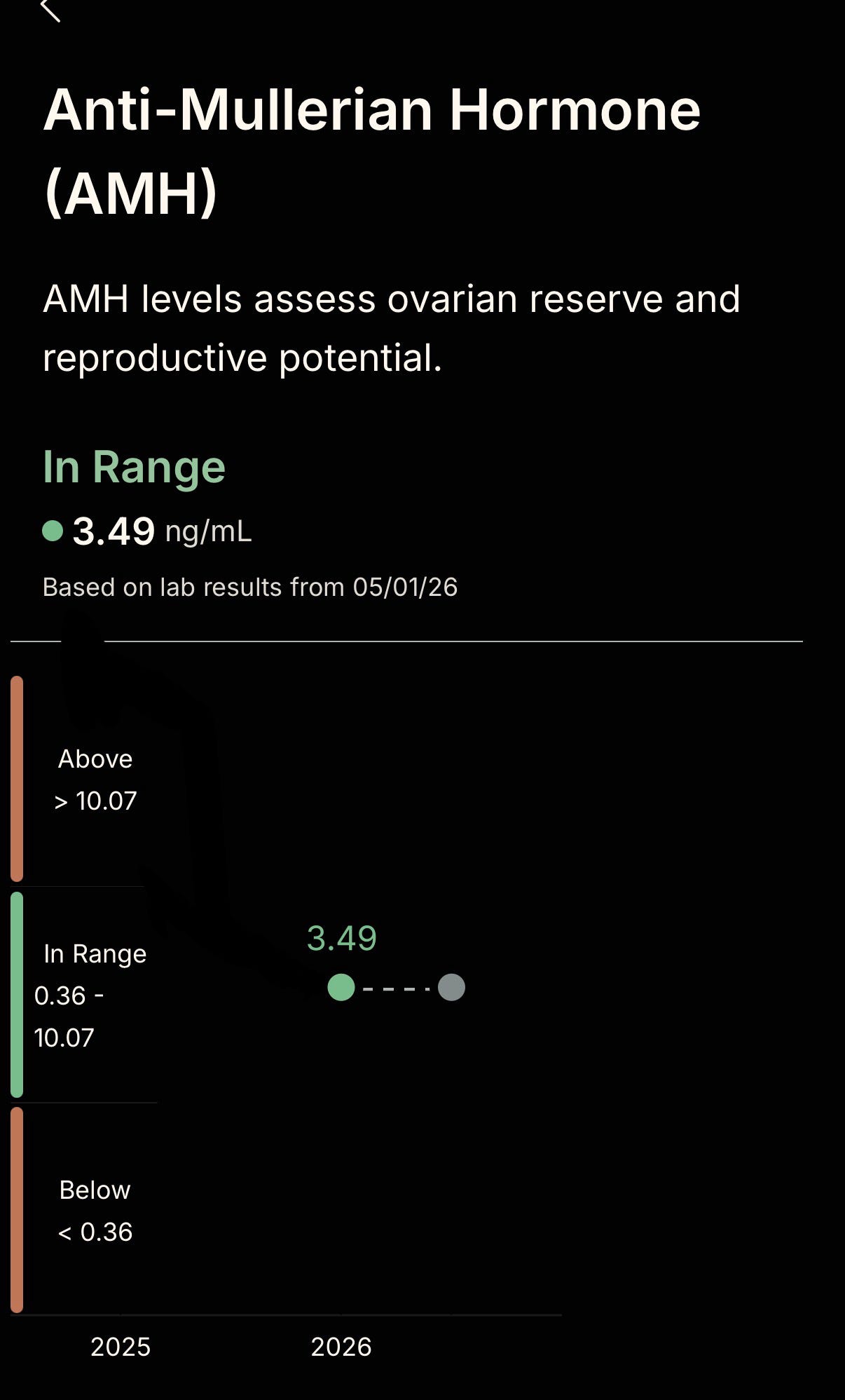
I am 34. My AMH is 3.49 ng/mL.
AMH is a proxy for ovarian reserve.
The median AMH for a woman my age is around 2.5. Mine is 3.49.
That puts me in line with the average woman in her mid-to-late 20s, not her mid-30s.
AMH is not a direct measure of fertility or egg quality.
But, IT IS a real signal of ovarian reserve and endocrine health, and mine is well above the average for my age.
I have never done IVF.
I have never frozen my eggs.
I have not spent a single dollar on the fertility industrial complex.
What I have done is protect the terrain that supports it: cleared my colon, supported my liver, opened my drainage pathways, and cleaned out the environmental toxins that scientifically drive endocrine disruption and diminished ovarian reserve.
I’ve been alcohol-free for 5 years.
I’ve been mostly caffeine-free for 4 years.
I haven’t been on any hormonal birth control in 5 years.
I eat organic whole foods, spend time in nature, get natural sunlight, sleep well, move my body every day, drink filtered water, have a regulated nervous system, live a life of purpose + meaning, and feel well surrounded by people I love.
I use non-toxic skincare and personal care products, avoid synthetic fragrance entirely, store my food in glass instead of plastic, and keep my home as low-tox as I possibly can.
None of this is radical.
All of it is protective.
Now, before anyone rushes to the comments: can I absolutely prove my choices caused this number? No. Genetics may deal the first hand, AMH varies from cycle to cycle, and one lab result is a snapshot, not a verdict. I won’t pretend otherwise.
But, every single exposure I just listed is scientifically linked to endocrine disruption.
And, I refused all of them.
I went deep on the bigger picture in this Monday's The Detox Weekly, including the full list of ways to support your fertility naturally. If you haven’t read it yet, it is the companion piece to this one.
Now, to the part no one wants to say out loud…
The fertility industry made $32 billion last year and is projected to hit $60 billion by 2032.
Its growth model depends on healthy women in their 30s believing their fertility is running out.
The women who genuinely need IVF absolutely deserve access to it.
But, the majority of women being sold egg freezing, hormone panels, and pre-emptive fertility interventions in their early 30s are being sold anxiety, not medicine.
Your body was designed for this.
The interventions that protect fertility are almost never the ones being sold to you.
Full disclosure: I am an angel investor in Function Health, which is where I got these labs pulled.
If you want to find out where your own hormones and terrain are right now and what to focus on first, take my free Cycle Audit Quiz and Hormone Health Scorecard.
If this resonated, I’d love to know: have you ever had your AMH tested? And, if you have, what were you told it meant? Let me know in the comments. I read and reply to every response.
If you’re ready to address the actual terrain rather than layer more interventions onto a system that hasn’t been cleared, I’m currently taking a very limited number of new 1:1 coaching clients heading into August. The first step is a 45-minute Client Intake call where we map your full picture and figure out together whether the work is the right fit for where you are. Book your free Client Intake call.
And, if you have any other questions or comments, don’t hesitate to ask me any time in my weekly Q&A in my paid subscriber channel. If you’re not a paid subscriber, sign up below.
If you found this helpful, here’s how you can help:
Tap the heart so that I know it resonated
Leave a thoughtful comment—I read and appreciate every one!
Forward to a friend who might need to hear it
Share it with your community on Substack Notes, Instagram (tag @meghanswidler), or LinkedIn (and tag me there too!)
Upgrade to a paid subscription below to support deeper work like this
Your support means more than you know.
Do you wish to have children one day, Meghan?
The caveat paragraph is what makes the rest of this land. Plenty of people would have posted the number and let the implication do the work. Saying plainly that genetics deal the first hand, that AMH varies cycle to cycle, and that one lab is a snapshot rather than a verdict costs you nothing and buys a lot of credibility.
The line I keep turning over is that the interventions that protect fertility are almost never the ones being sold to you. That reads less like a fertility observation than a structural one: prevention is close to unsellable because there is no unit to ship. You cannot build a $32B category on "filter your water, skip the synthetic fragrance, don't drink," so the category gets built on the intervention downstream instead and the upstream stuff stays unmarketed by default. Not a conspiracy, just what the incentives produce.
Which is also why this kind of thing tends to travel through writing like yours rather than through anyone's marketing budget.